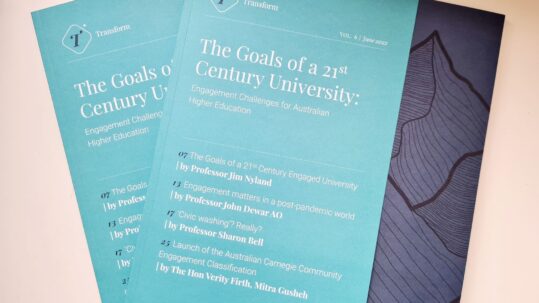
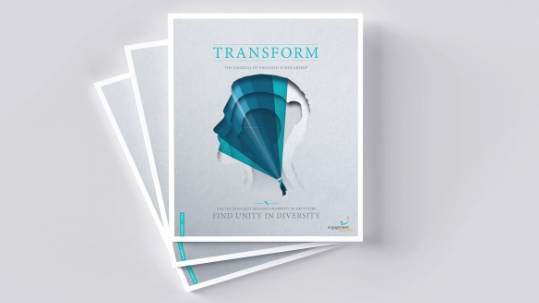
Transform: The Journal of Engaged Scholarship is an open-access, peer reviewed, multi-disciplinary online platform for engaged scholars and practitioners.
Published annually, the Journal will feature articles that advance the scholarship of engagement within Australia and internationally, providing space for critical inquiry, reflection and review. The Journal includes current and recently completed research, practice-oriented research, and reviews of practice relevant to engagement in the Higher Education sector.
Engagement Australia welcome submissions from the research, conceptual, theoretical and practice domains across the breadth of the engagement agenda in higher education.
Note: Transform, as the official journal of Engagement Australia promotes the Australian Carnegie Community Engagement Classification and its definition of community engagement and reciprocal partnerships. Research articles, theoretical and conceptual articles, practice articles, and case studies should address/discuss the engaged processes (i.e., the nature of the reciprocal partnership/s), and outcomes/impacts of their topic of focus as consistent with the Carnegie definition.
The Editorial Board invites manuscript submissions to the following five sections:
1. Research articles that report on the findings of empirical studies of higher education engagement with communities. The journal is open to a variety of methodologies which may be qualitative, quantitative, or mixed methods.
2. Theoretical and conceptual articles (that examine the theoretical and conceptual approaches to higher education engagement with communities)
3. Practice articles (that examine the practice of higher education engagement with communities)
4. Case Studies that report on engaged projects and programs in the sector (1500 – 3000 words – No abstract necessary)
5. Book reviews (of recent publications in higher education engagement with communities and related fields (reviewed by editorial committee)
Author Guidelines and submission structure
Ethics and ethical publication practice – For research articles, practice articles, and case studies, authors reporting qualitative or quantitative data should have received ethical clearance from their institutional ethics committee (or equivalent) or an appropriate exemption statement from the committee. Authors may reference data from an annual report, or program evaluation, however, this should be cited within the paper and occur in the appropriate place in the reference list.
Please include a statement with your manuscript that ethical clearance has been gained (or exempted) where relevant for research articles, practices articles, and case studies.
The submitted work should be the author/s’ original work and author/s should ensure that the manuscript has not been previously published nor is being considered by another journal. Authors should pay careful attention to referencing and be sure not to misappropriate others’ work as their own, nor attribute this work to another author.
Generative AI and AI-assisted technologies – Transform does not encourage the use of generative AI and AI-assisted technologies in the production of original manuscripts. Where AI is used to improve the readability of work, careful review and edit of the work should occur as AI can produce incorrect information, interpretation, or misleading communication of academic and intellectual concepts. If having used generative AI or AI assisted technologies, a statement must be provided in the manuscript that will also be present in the final paper if accepted.
Referencing – content should be properly referenced utilising APA 7th edition citation style.
Word Count – while there is no maximum length for manuscripts, authors are encouraged to write concisely. Generally, a complete manuscript falls between 6,000 to 8,000 words excluding references, tables, and figures. (Case studies have a maximum of 3000 words)
Format – manuscripts should be submitted in Microsoft Word document file format. The text should be in double-spaced, 12-point Times New Roman font, single column format. Formatting should generally follow APA 7th edition style however Keep the layout of the text as simple as possible with no more than two levels of headings.
Author name/s and affiliation – all authors should include their full names, affiliations, postal addresses, telephone numbers and email addresses on the cover page of the manuscript.
Title – should be concise and informative. Abstract – a concise and factual abstract of no more than 250 words is required.
Key words – provide up to six key words for indexing purposes.
Acknowledgements – should not be included in the manuscript to preserve anonymity during the review process. Please submit your acknowledgements/very brief author’s biographical statement as a separate file, clearly titled, when you submit your article. They will be added to your paper once the refereeing process is complete.
Photos and Bios – Transform likes to include author photos and bios. Please include high resolution photos along with short 150-word bios of each author with your submission (except for case studies and book reviews)